MTV: 10 Off-Beat San Diego Panels You Have To See To Believe

MTV Geek post by Alex Zalben:
http://geek-news.mtv.com/2011/07/13/10-off-beat-san-diego-panels-you-have-to-see-to-believe/

“…You can finish up CCI with what is possibly the most erudite panel on the schedule. Some might call it, ‘the nerdiest panel,’ but not this guy, as it actually sounds kind of fascinating, and calling something the nerdiest at CCI is like going into the sea, pointing to a mackeral, and saying, “You’re the fishiest.” But after four days of watching superguys punch each other, maybe its good to leave with a little education?”

Comics Arts Conference: WonderCon 2011

Comics Arts Conference 5:
Life After Trauma — To Be a Superhero or Supervillain?

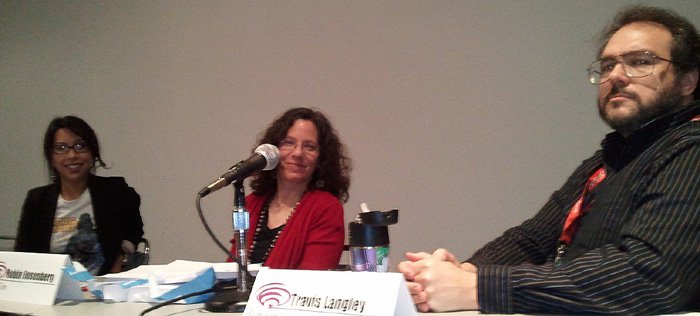
Speaker/Artist(s) Info Andrea Letamendi, Robin Rosenberg, Travis Langley.

Did you ever wonder why experiencing trauma led Batman to become a hero but Harvey Dent to become a villain? Why Superman hasn’t given up his Herculean task for good after being exposed to so much loss, stress, and destruction? What makes superheroes keep fighting without getting burnt out, disillusioned, or becoming villains? Join psychologists Andrea Letamendi (UC San Diego), Robin Rosenberg (Psychology of Superheroes), and Travis Langley (Henderson State University) as they address these questions, applying what we know about trauma in our world to the world of superheroes to better understand why the same types of events can lead some folks to heroism and others to villainy.

Newsarama coverage by Jill Pantozzi:
Experts Ask & Answer: Trauma – What Makes Heroes & Villains?

Graphic Novel Reporter coverage by Doré Ripley:
Happy Birthday, WonderCon – A Review of the Show.

Comics Arts Conference 6:
Understanding Superheroes

Speaker/Artist(s) Info: Dyfrig Jones, Travis Langley
About Dyfrig Jones (Bangor University) presents the current Creu Arwyr research project, funded by the Welsh government, in which the pupils of Ysgol Syr Huw Owen are working with artist Mike Collins (Freakhouse Graphics) to create new superheroes and write narratives for these characters based in the community around the school. Travis Langley (Henderson State University) takes a psychological look into the mind of the on-screen Batman.

Arkansas Democrat-Gazette

FRONT AND CENTER:
Travis Langley

Professor teaches by exploring the psyche of superheroes

By Wayne Bryan

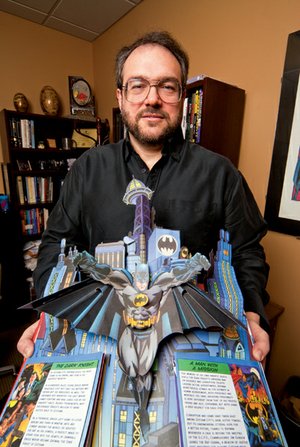
Travis Langley, a psychology professor at Henderson State University in Arkadelphia, is writing a book about Batman. Langley uses the superhero’s disturbed psyche as an example to help teach his students.

Photo by Rusty Hubbard

Travis Langley, a psychology professor at Henderson State University in Arkadelphia, is writing a book about Batman. Langley uses the superhero’s disturbed psyche as an example to help teach his students.

ARKADELPHIA — What does Batman tell us about ourselves? Perhaps an even better question is, what do our thoughts about him and the fact that so many people think about Batman say about our society?

Travis Langley, Ph.D., a professor at Henderson State University in Arkadelphia, researches those questions and uses the words and deeds of superheroes to study how people interact and relate to others… (continued)

Go to complete article:
http://www.arkansasonline.com/news/2011/feb/13/front-and-center-travis-langley/

Siftings-Herald: Professor, Students Probe the Mind of the Joker

Travis Langley (left) and Adam West (right) discuss Cesar Romero while preparing for their Comic-Con panel on the psychopathy of the Joker.

Dr. Travis Langley, professor of psychology at Henderson State University, recently probed the mind of a master criminal with the help of one of the world’s most famous detectives. We are speaking, of course, of killer clown Joker and his nemesis, Batman.
Langley, along with a contingent of students and faculty from Henderson, attended Comic-Con International in San Diego, Calif,. on July 25…. (continued)

Comic Book Literacy: Wizard World University

This year Wizard World Texas hosted Wizard World University, an academic track of programming created alongside the Institute for Comics Studies. Saturday’s “Comics in the Classroom” panel featured none other than CBL producer Khindra Kent and her presentation, ” Comic Book Literacy in the Early Childhood Classroom….”

Go to full post by Todd Kent.

Addendum (04/11): I still haven’t seen the Comic Book Literacy documentary, but I hear that I show up in it twice, including a nice except from the interview that was going on when the photo above got taken.

Oracle: Comic Arts Club Offers Excitement

Club activities are definitely going to get a lot more animated this year, courtesy of the Henderson Comic Arts Club. Under the supervision of Dr. Randy Duncan and Dr. Travis Langley, the Comic Arts Club – or Comics Club, as it’s more commonly known – is proving that fans have evolved far past the stereotypes of 5-year-old boys and basement-dwelling “Comic Book Guys.”

One of the club’s most fascinating accomplishments is the ERIICA project. ERIICA – which stands for Empirical Research on the Interpretation and Influence of the Comic Arts – studies the mental and emotional states of comic book fans. The project was originally conceived by Langley during a 2007 trip to the San Diego Comic-Con. “We wanted to know why these people want to go to these conventions and stand in line for hours to see a panel they’ve already been told they won’t be able to see,” says Langley. “We want to see if these people feel more accepted here in an environment that appreciates the interests they have and who they are.” (continued)


Democrat-Gazette: Comic communication topic of professors’ classes

Dr. Randy Duncan and Dr. Travis Langley, professors at Henderson State University, have a love for comics that runs deeper than buying the occasional comic book or watching the latest Batman movie.

They both teach classes on the subject of comics and took 16 HSU students attended the Comic-Con International in San Diego, which began Thursday and ends today.

Langley is a psychology professor, and he said his love of comics came before he could even read.

“When I was 4 my mom was reading me Batman,” Langley said.

Langley teaches a comics and psychology course at HSU, and he said the course is a psychological study of sequential art literature, like comic books and graphic novels, exploring its structure, function and psychological value… (continued)

Go to full article by Elizabeth Pannell.

Golden Gate [X]Press: We Can Be Heroes

Doctor Travis Langley, a psychology professor at Henderson State University in Arkansas, says that people enjoy comics mainly for the escapist storylines and the opportunity for exposure to new characters and adventures. The more access people have to comics, in terms of how many comic book stores are in their residential or working community or how many comics are sold in their local grocery store, will determine how much a person will involve themselves in the hobby.

“A lot of people, especially younger people, when they watch these cartoons and movies, they start to see traits in these characters that they like, that they want in themselves that they really don’t have,” says Thomas Seepe, one of Langley’s students who is also helping him with the study. “Like superpowers, for example. You’ll start to see when people work towards an obsession. They want to become these characters. They love these characters. They take that character on as another persona. Why do we go to watch movies? We go to watch to act like we’re there, like we’re Indiana Jones.” (continued)

Go to full article by Syed Ali.

Oracle: Vampires and Superman Among Fall Topics

…Last on the list of interesting classes is a course taught by Dr. Travis Langley called “Forensic Psychology.” The class is popular among students because it teaches the psychology of crime, crime solving and court processes. The class also discusses topics such as con artists, domestic violence, sex crimes, lie detection, jury selection, terrorism, the insanity defense and many more.

“I sometimes have to point out to the students that our time is up because they have gotten so wrapped up in the topic of conversation,” says Langley.

Go to full article by Sarah Bumpas.